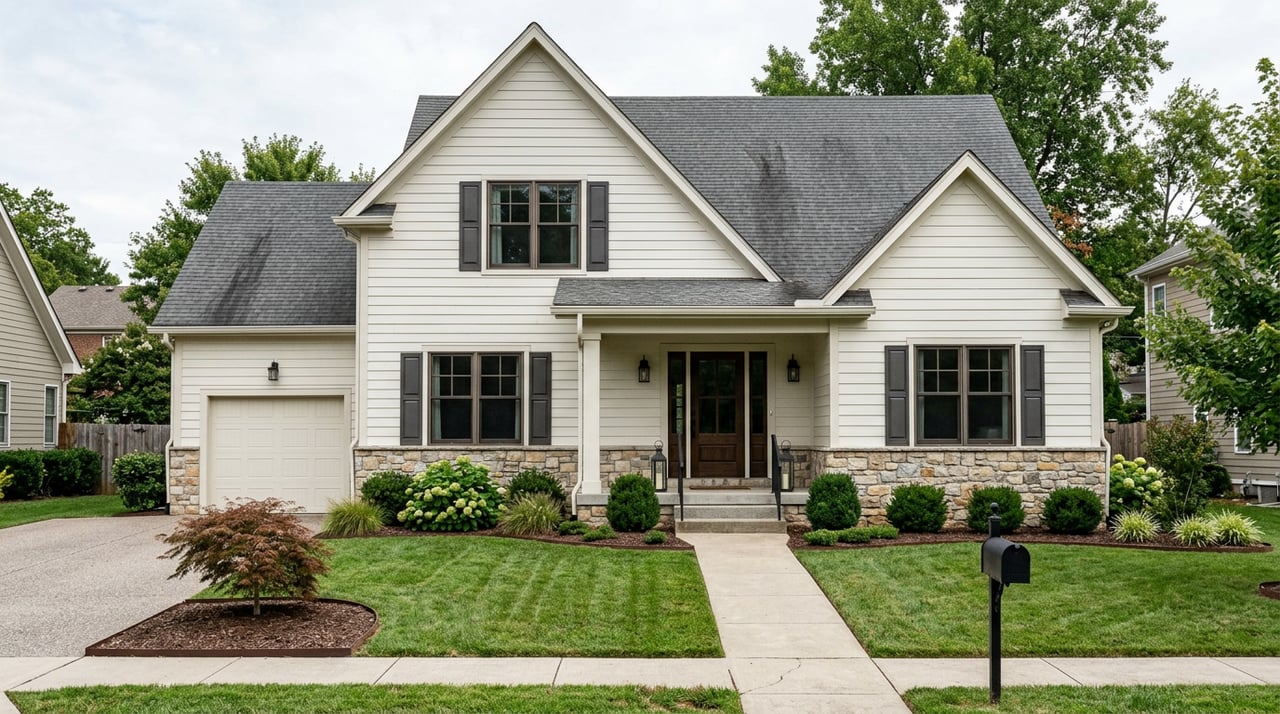
The Line Near BYU That Decides What a Provo Home Is Actually Worth
September 3, 2026
September 3, 2026
Pull up three different sources for the Provo housing market this summer and you'll get three different stories. One index puts the average home value at just under $490,000 as of late June 2026, up slightly from a year earlier. A local MLS snapshot for July 2026 shows closed sales at a median of nearly $560,000, with unsold inventory asking closer to $495,000. A market brief written in early 2026 pegged the citywide median in the mid-$420,000s. None of these numbers are wrong. They're measuring different things, and the gap between them tells you more about how Provo actually works than any single figure could.
Provo is a small enough market that a handful of closings can swing the median by tens of thousands of dollars in either direction. Sell a run of starter condos near campus one month and the number drops. Sell a cluster of East Bench homes with mountain views the next and it jumps. That volatility isn't noise. It's a symptom of something buyers researching Provo from out of state rarely find explained: this city runs on two parallel housing markets that happen to share a zip code, and the line between them isn't drawn by price, size, or neighborhood name. It's drawn by an occupancy ordinance.
Provo's zoning code sets a default occupancy limit for most residential properties: one family, or three unrelated adults. That single rule, tucked into Title 14 of the city code, does more to shape value near campus than square footage or lot size ever could.
A five-bedroom house a half mile from BYU can look, on paper, like a strong rental investment. But if it sits in a standard single-family zone, the law caps it at three unrelated occupants regardless of bedroom count. A nearly identical house a few blocks over, sitting in a zone or building approved for higher occupancy, can legally house more tenants and collect meaningfully more rent for the same physical structure. Neither home is better built. The difference is a zoning designation that isn't visible from the street or the listing photos.
Provo doesn't take casual guessing on this lightly, either. Since a 2017 city council vote, knowingly violating an occupancy limit has carried criminal penalties: up to 90 days in jail and a $750 fine for a first offense, rising to six months and $1,000 for a second. The city's code compliance office will confirm a property's actual zoned occupancy for a $25 fee, with a turnaround of about ten business days, and anyone buying near campus with rental income in mind should treat that verification as a non-negotiable step before writing an offer, not an afterthought after closing.
This is also the ordinance behind the term you'll see in Provo's zoning definitions: a "baching singles" arrangement, which the code recognizes as four or more unrelated adults or college students sharing a unit, but only where the specific zone authorizes that count. Most don't. A few condo complexes and purpose-built student housing developments near campus do, and those properties have historically carried a value premium precisely because the occupancy math works in the owner's favor.
Once you look at Provo through the zoning lens instead of the median, the neighborhood-by-neighborhood picture gets a lot more specific.
| Area | Typical price band (2026) | What actually drives the number |
|---|---|---|
| East Bench (Edgemont, Oak Hills, upper Grandview) | Roughly $500,000–$800,000+, with view lots pushing higher | Elevation, lot size, and distance from the rental market, not campus proximity |
| Tree Streets / Rock Canyon | Mid-range, character-driven | Established tree-lined streets, walkability, direct trailhead access |
| Downtown / Center Street corridor | Condos and mixed-use from under $350,000; renovated historic homes higher | Walkability and an active redevelopment pipeline, offset by older housing stock needing updates |
| South Provo / Lakeview | The most accessible single-family entry point in the city | Distance from the mountains and campus, older stock, some newer construction on the city's edges |
| Near-campus, undergrad boundary | Value split by zoning status more than by size | Occupancy cap: three unrelated tenants by default, four in a handful of approved complexes, a rare exception approved for six |
The East Bench commands a premium because it's furthest removed from the rental cycle, not because it's inherently more desirable. South Provo is the affordability play precisely because it sits outside the zones where investor competition drives prices up. And the near-campus tier is the one where a buyer's intended use, live-in versus rental, changes what the same address is actually worth.
BYU enrolls somewhere in the range of 32,000 to 34,000 students in a city of about 115,000 people, and that ratio means the rental market and the for-sale market move together in ways they don't in most cities. Student leases overwhelmingly turn over in late summer, ahead of fall semester, so rental demand peaks in roughly July and August.
For anyone buying near campus with an eye toward rental income, that calendar has real consequences. A purchase that closes in spring or early summer gives an owner time to have a unit rent-ready before that leasing peak. A purchase that closes in October often means carrying a vacancy until the following summer's cycle, a cost that should be priced into the offer, not discovered after the fact. This is one more reason the same house can pencil out very differently depending on when in the year a deal actually closes.
If you're weighing Provo against the rest of Utah Valley, one more piece of the puzzle is still being decided a few miles from downtown. Brixton Capital, the California-based firm that has owned Provo Towne Centre since 2016, is working with Provo-based PEG Companies on a roughly $500 million plan to convert 23 acres of East Bay, mall included, into an indoor-outdoor mixed-use district. The concept would keep Target, JCPenney, and Cinemark as anchors while adding about 1,300 apartments across five buildings and 83 townhomes, most of them on the site of the Shady Acres mobile home park.
The Provo Planning Commission voted unanimously in March 2026 to recommend a rezone to the city's Interim Transit-Oriented Development designation, but voted 6-2 to continue rather than approve the actual concept plan, citing concerns about traffic, walkability, and what happens to Shady Acres residents. The rezone moved to City Council that April, and as of this summer the project was still working through approvals rather than final sign-off.
If it eventually moves forward, it would be one of the largest single housing injections Provo has seen in years, concentrated in East Bay rather than spread evenly across the city. That matters for anyone evaluating South Provo and the East Bay corridor specifically: a meaningful supply increase there could ease competition in that submarket even if the rest of the city's inventory picture doesn't change much.
None of this is a reason to distrust every number you see quoted for Provo. It's a reason to ask a more specific question than "what's the median?" If a property sits anywhere near the BYU undergrad boundary, the first question isn't the asking price. It's whether the zoning supports the occupancy the seller or listing agent is implying, and a Zone Verification letter from the city answers that in about ten business days for $25. If a property sits on the East Bench or in South Provo, the driving factors are more conventional: lot, elevation, distance to amenities, and how recently the home has been updated.
Buyers relocating to Utah County often start by comparing Provo's median to Salt Lake City's or Lehi's, without realizing Provo's own median is doing more internal work than most citywide figures. A market this size, with a university this large sitting inside it, doesn't average out the way bigger, more uniform metros do.
If you're weighing a purchase in Provo against options elsewhere in Utah Valley, or trying to figure out whether a specific property's occupancy status matches what you're being told, that's exactly the kind of question worth walking through before you write an offer. You can browse what's currently available across Provo or get a clearer read on where your budget actually lands with a free home valuation.
Does the occupancy limit apply to homes I'd live in myself, not rent out? The three-unrelated-adult default applies to the property regardless of who lives there, but it only becomes a practical issue if you're renting to multiple unrelated tenants. A family living in the home isn't affected by this rule.
How do I find out a specific property's approved occupancy before making an offer? Request a Zone Verification letter from Provo's code compliance division. It costs $25 and typically takes about ten business days, and it's worth building that lead time into your offer timeline if occupancy matters to your plans.
Is the Provo Towne Centre redevelopment going to affect home values right away? Not immediately. The project was still moving through city approvals as of this summer, with no final decision announced. It's worth tracking if you're specifically considering East Bay, but it isn't a factor that should change a decision elsewhere in Provo today.
Provo's market rewards buyers who ask better questions than the median can answer. If you want a read on a specific address, or want to talk through how these submarkets compare to what you'd get in Salt Lake City, Lehi, or Draper, Isabel Hutchings is glad to walk through it with you. Let's Connect — Schedule Your Free Market Consultation.
Stay up to date on the latest real estate trends.
Dedicated to helping you find the right home with care and integrity. Whether buying or selling, she listens to your needs and guides you through every step with patience and expertise. Your home journey starts here.
Isabel Hutchings
Berkshire Hathaway HomeServices Utah Properties
6340 South 3000 East Suite 600
Salt Lake City Utah 84121
Berkshire Hathaway HomeServices Nevada Properties
3185 St Rose Parkway Suite 100
Henderson Nevada 89052